International Conference on the Cuanza Corridor
"Cuanza Corridor: History, Culture, Economy and Tourism — Bridges Between the Past, the Present and the Future." A joint initiative of Associação Chiandanda, the Ministry of Culture and the Provincial Government of Icolo e Bengo, with international scope.
Official flyer — Save the Date
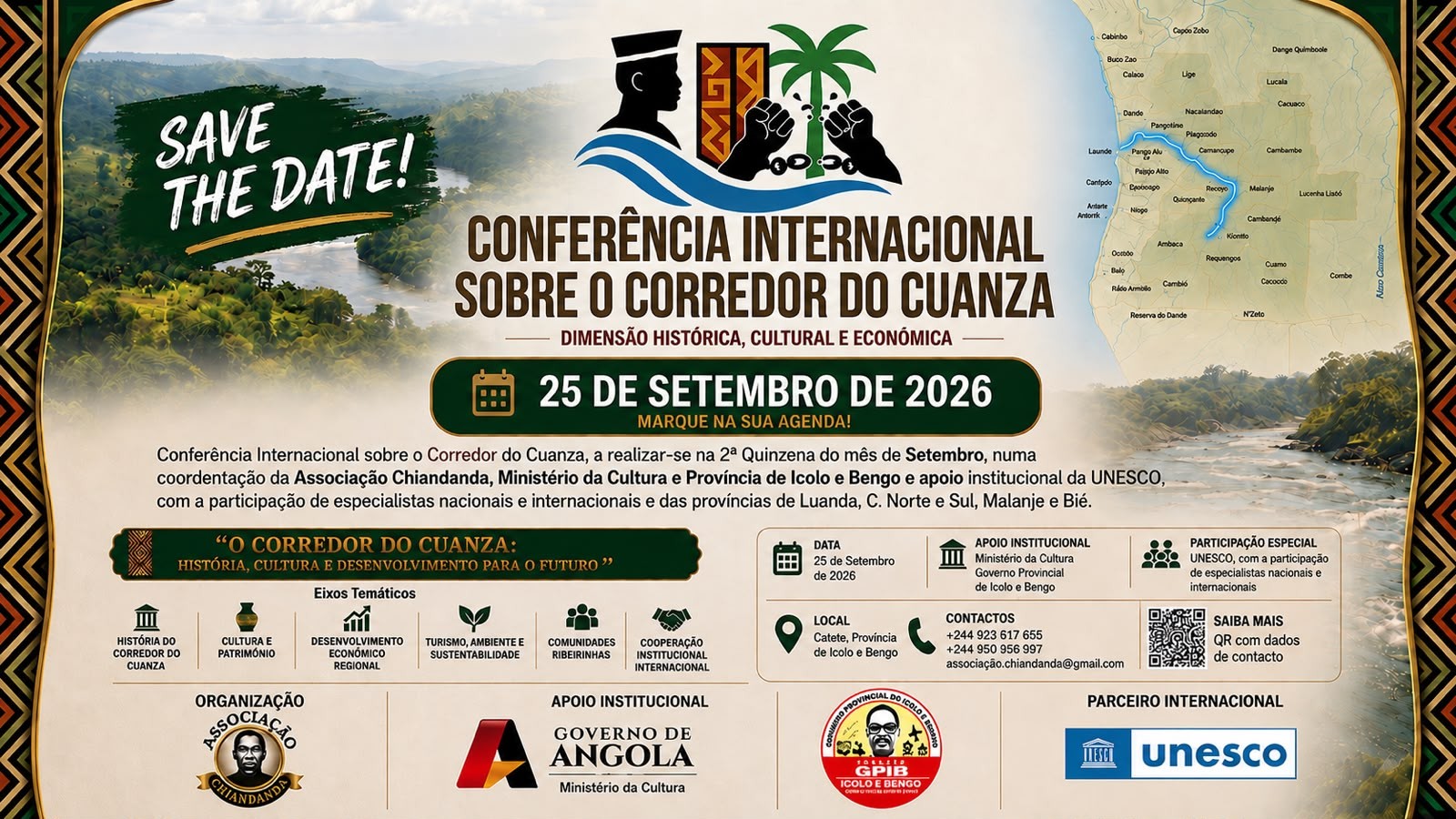
The flyer brings together, in a single poster, this conference's own visual identity: the event emblem, the map of the Cuanza Corridor, the thematic axes and the institutional supporters confirmed so far.
Use it to share the date on social media, send it to partners and guests, or display it in public spaces across the provinces involved.
A space for reflection on the Cuanza's past and future
The Cuanza is one of Angola's most important natural, historical, cultural and economic axes. The Cuanza Corridor represents far more than a geographical reality: it is a space with extraordinary potential for an integrated vision of development, grounded in the enhancement of historical and cultural heritage, the boosting of economic activity, the promotion of tourism, and the creation of new opportunities for local populations.
The Conference will bring together specialists, researchers, academics, business leaders, institutional representatives and other stakeholders from Angola and different countries — with expected participation from Portugal, Brazil, the Netherlands and the United States of America — offering a multidisciplinary and international approach to the historical role and future prospects of the Cuanza Corridor.
Key conference details
| Date | 25 September 2026 |
|---|---|
| Location | Catete, Municipality of Icolo e Bengo — Dr. António Agostinho Neto Cultural Centre |
| Organised by | Associação Chiandanda, Ministry of Culture and Provincial Government of Icolo e Bengo |
| Scope | International |
| Participants and guests | 150 to 200 people, including academics (historians, economists, sociologists, engineers), business leaders, students, traditional and religious authorities and civil society organisations, from Angola, Brazil, Portugal, the Netherlands and the USA |
| Remote participation | Non-resident participants may take part remotely via Zoom, Teams or another platform, with a link to be provided in due course |
| Length of talks | Maximum of 15 minutes per talk; Q&A interventions limited to 2 minutes |
| Interpretation | Simultaneous interpretation into English, if needed |
| Certification | Certificate of participation for guests |
| Institutional outcome | Reading and publication of a closing statement — the Declaration of Catete on the Cuanza Corridor |
| Estimated budget | AKZ 10,000,000.00 to AKZ 12,000,000.00 |
| Funding | Associação Chiandanda and partnerships |
25 September — conference day
Morning — Opening session and first panel
Arrival of participants and guests
Conference begins — opening session
Master of ceremonies to be designated by the Provincial Government of Icolo e Bengo. Presidium: invited national protocol entity, Provincial Governor of Icolo e Bengo, representative of the Ministry of Culture, Municipal Administrator of Catete, and representative of Associação Chiandanda.Welcome speeches and presentation of the Association
Welcome by the Municipal Administrator of Catete; presentation of Associação Chiandanda and the conference's objectives by the Executive Coordinator, Domingos Manuel Eduardo, and by the President, Rev. Bishop Manuel João Eduardo; opening address by His Excellency the Minister of Culture or a designated protocol entity.Coffee break
Panel I — The historical and cultural dimension of the Cuanza Corridor
Moderated by a historian designated by MINCULT. Keynote speaker: Dr. João Pedro Lourenço (MINCULT). Panel: Prof. Dr. Alberto Oliveira Pinto (Portugal), Prof. Dr. Rafael Galante (Brazil), Prof. Oscar Hefting, New Holland Foundation (Netherlands), representative of the National Commission for UNESCO. Followed by a Q&A session.Panel II — The economic, social and development dimension
Moderated by an economist designated by Associação Chiandanda. Keynote speaker: economist Dr. Samora Machel Januário e Silva, on agro-industry, energy potential and mining potential in the Cuanza Corridor. Panel: representatives of the Cuanza Corridor provinces and invited academic institutions. Followed by a Q&A session.Afternoon — third panel and closing
Lunch break
Panel III — The tourism dimension of the Cuanza Corridor
Moderated by a representative of the Provincial Government of Icolo e Bengo. Keynote speaker: Dr. Belvânio Tyaunda (Ministry of Tourism). Panel: representative of the Ministry of Environment, representatives of the Cuanza Corridor provinces and invited academic institutions. Followed by a Q&A session.Closing session
Reading of the closing statement by the secretariat and closing address by His Excellency the Provincial Governor of Icolo e Bengo.26 September — Saturday
Tourist boat trip along the Cuanza River, in Calumbo, Icolo e Bengo (to be confirmed)
Four dimensions of the Cuanza Corridor
The conference's framework document organises the discussion into four major axes, open to contributions from academics, institutions and communities.
I. History and memory
- The Cuanza in Angola's historical formation
- Peoples and communities of the Cuanza valley
- Kingdoms, chiefdoms and traditional structures
- The Portuguese and Dutch presence in the region
- The transatlantic slave trade
- Massangano, Muxima, Dondo and Catete
- Archaeology, memory and identity
II. Culture, identity and heritage
- Cultural identities of the Cuanza Corridor
- Traditions, languages and intangible heritage
- Music, dance and cultural expressions
- Crafts and the creative economy
- Religious heritage and heritage education
- Candidacy for UNESCO World Heritage status
III. Economy and development
- Agriculture, agro-industry and food security
- Livestock, fisheries and aquaculture
- Mineral resources and hydroelectric energy
- Logistics platforms and infrastructure
- Entrepreneurship and youth employment
- Public-private partnerships and investment
IV. Tourism and territorial development
- Historical, cultural and religious tourism
- Ecotourism and nature tourism
- River and adventure tourism
- Massangano–Muxima–Dondo–Catete route
- Community tourism and hospitality
- Territorial marketing and international promotion
Sponsorships and projects that may emerge from the conference
Structuring projects to be identified
- Historic Cuanza Route and Massangano–Muxima–Dondo itinerary
- Cuanza Study and Research Centre
- Museum or interpretation centre for the Cuanza Corridor
- Historical, religious and nature tourism itineraries
- Marketing platforms for agricultural produce
- Digital platform for the Cuanza Corridor